Skip to content

Construction administration guide · By Yes AI

Questions to ask before AI reads project documents

Published 5 min read

Project documents carry more personal information than most builders expect, from licence numbers in subcontractor files to faces in site photos. This guide lists the questions to put to any AI provider before it reads your documents, and what a good answer looks like. It is administrative guidance, not legal advice; check your obligations with the OAIC or a privacy lawyer.

Quick answer

Before an AI service reads your project documents, find out where files are processed and stored, whether they are used to train the provider's models, who can access them, how long they are kept and how a breach would be reported to you. If your business is covered by the Privacy Act, personal information in subcontractor records and site photos brings obligations, including for overseas disclosure. The OAIC expects due diligence before adopting a commercial AI product.

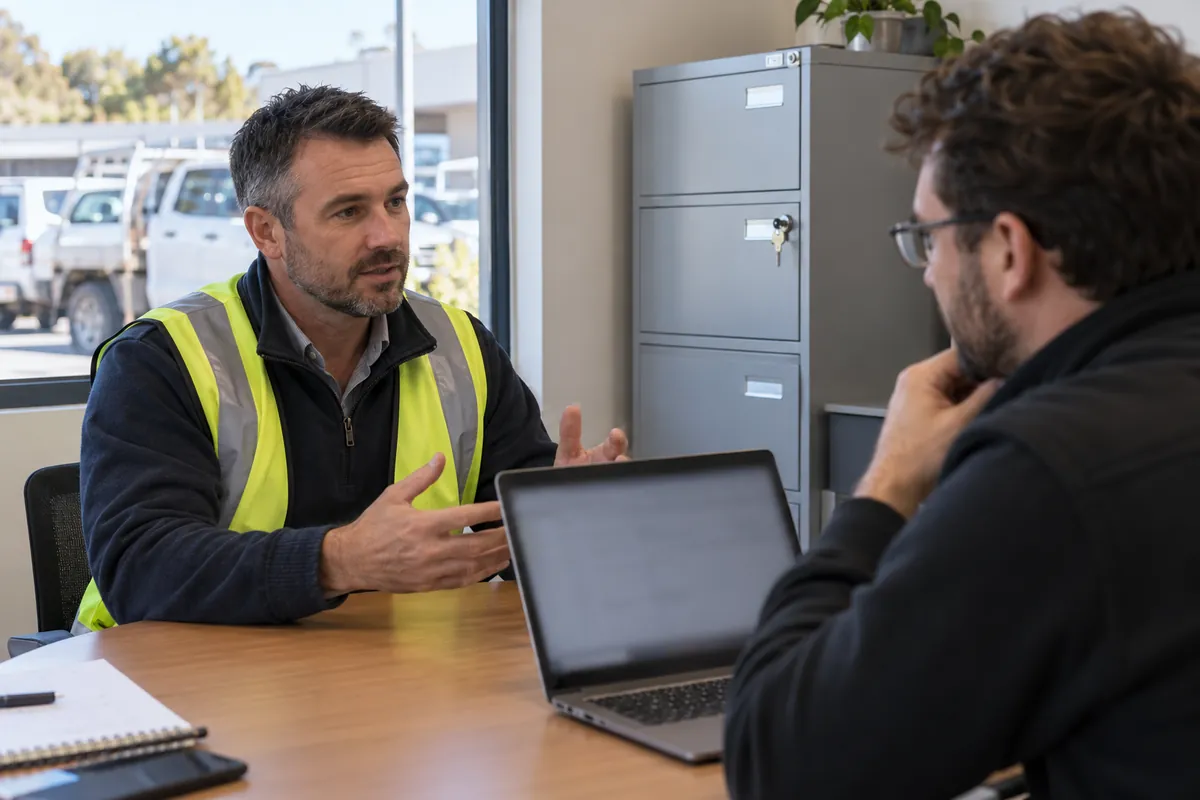
Operations manager and IT contractor discussing data access at a builder's office with a locked filing cabinet behind

What personal information is in construction documents?

More than the contracts suggest. Subcontractor files hold names, phone numbers, licence numbers and insurance details. Induction records list individual workers. NSW subcontractor's statements refer to wages and payroll tax. Incident reports describe injuries. Site photos show people. The OAIC says privacy obligations apply to any personal information put into an AI system, and to output that contains personal information. Map which document types in the proposed workflow contain personal information before deciding what the service may read.

Does the Privacy Act apply to your business?

The OAIC says most small businesses with annual turnover of $3 million or less are not covered by the Privacy Act, but some are regardless of turnover. One listed category is a contractor that provides services under a Commonwealth contract, which matters to builders working on federal projects. Turnover for this purpose includes all income from all sources. The OAIC publishes a privacy checklist for small business. Even if the Act does not cover you, your head contracts may impose confidentiality and privacy terms that any provider must also meet.

Where are the files processed and stored?

Ask the provider to name the countries where your documents and the model processing sit, including any sub-processors. Under Australian Privacy Principle 8, before an organisation covered by the Act discloses personal information to an overseas recipient, it must take reasonable steps to ensure the recipient does not breach the APPs, and it is generally accountable for what the recipient does with the information. Exceptions exist, so get advice on your situation. A provider that cannot tell you where processing happens cannot help you meet that obligation.

Will your documents be used to train a model?

Ask, and get the answer in the contract. Business and API terms from model providers commonly differ from consumer terms, so check which apply. The larger risk is often inside your own business: staff pasting documents into free chatbots. The OAIC recommends, as best practice, that organisations do not enter personal information, and particularly sensitive information, into publicly available generative AI tools. A short written rule for staff covering what may and may not be pasted into which tools is worth adopting before any automation project starts.

Ask for the provider's data processing terms before any demonstration with real documents. Until they are agreed, use made-up or redacted examples. Remember that commercial information needs protecting too: tender prices, subcontract rates and the client's design documents are usually confidential under your contracts even when they contain no personal information.

Who can access the documents and the outputs?

The OAIC lists who will have access to personal information put into or generated by an AI product as part of the due diligence a business should do. Access questions apply to the provider's staff, to its sub-processors and to your own people, because a shared login or an over-broad project permission lets people see records they do not need. Ask the provider these questions and expect specific answers rather than a link to a general security page.

  • Which of the provider's staff can see your documents, and under what conditions?
  • Can access be limited to the projects in scope?
  • Are actions logged, and can you review the logs?
  • How is access removed when a staff member or project finishes?

What happens if there is a data breach?

Under the Notifiable Data Breaches scheme, an organisation covered by the Privacy Act must notify affected individuals and the OAIC when a data breach is likely to result in serious harm to someone whose personal information is involved. If a provider holding your documents has a breach, you need to know quickly to meet that duty. Ask how and how fast the provider will tell you, what information it will give, and put that in the contract. Ask what happens to your documents when the contract ends and how deletion is confirmed.

Questions for an AI provider and the answers to look for

QuestionWhy it mattersAnswer to look for
Where are documents processed and stored?Overseas disclosure obligations under APP 8Named countries, including sub-processors
Are our documents used for training?Control over confidential project informationA clear no, written into the contract
Who at the provider can access our data?Exposure of personal and commercial informationNamed roles, logged access, limited by project
How long are documents kept?Holding data longer than needed increases riskA stated retention period and confirmed deletion
How will you tell us about a breach?Your duties under the Notifiable Data Breaches schemeA timeframe and contact process in the contract
Can we export and leave?Continuity if the service endsExport in a standard format, then deletion

Practical checklist

  • The document types the service may read, and those it may not, are agreed in writing.
  • Processing and storage locations are named, including any overseas sub-processors.
  • The provider confirms in writing whether your data is used to train models.
  • Access is limited to the projects and staff in scope, with logs you can review.
  • Breach notification to you, and deletion at the end, are set out in the contract.
  • Staff have a written rule about pasting project documents into public AI chatbots.

Common questions

Is our company too small for the Privacy Act?

Possibly. The OAIC says most businesses with annual turnover of $3 million or less are not covered, but several categories are covered regardless, including contractors providing services under a Commonwealth contract. Use the OAIC's small business checklist or ask a privacy lawyer, and check your head contracts for privacy terms either way.

Are drawings and contracts personal information?

Mostly they are commercial documents, protected by confidentiality terms rather than privacy law. They can still contain personal information, such as names, signatures and contact details. Contracts with your client may restrict where project documents go, so check those terms before any provider handles them.

Do we need a privacy impact assessment?

The OAIC recommends a privacy by design approach for organisations considering AI products, including a privacy impact assessment. For a workflow that reads subcontractor records or incident reports, a short assessment of what personal information is involved and where it goes is a practical first step.

What about site photos that show workers?

The OAIC notes that many photographs of individuals contain sensitive information. Keep progress and defect photos focused on the work where you can, and check whether a workflow needs images of people at all. Where it does not, exclude those photos from what the service reads.

Can we use a free chatbot for a quick summary?

Not for documents that contain personal information, under OAIC best practice. Free consumer tools may also have terms that allow the provider to use what you enter. Use tools covered by a business agreement, and keep the staff rule simple enough to follow on a busy day.

Sources and further reading

Continue planning

Plan the next improvement to your project administration

Describe the document workflow, project systems and handover causing delays. We can discuss a bounded admin pilot and the checks your project team needs. Keep contracts, personal records and confidential project files out of this enquiry.